

BOSTAA 2026 Annual Meeting
Differences in Critical Shoulder Angle Between Glenohumeral Osteoarthritis and Rotator Cuff Tears
A Retrospective Radiographic Cohort Study
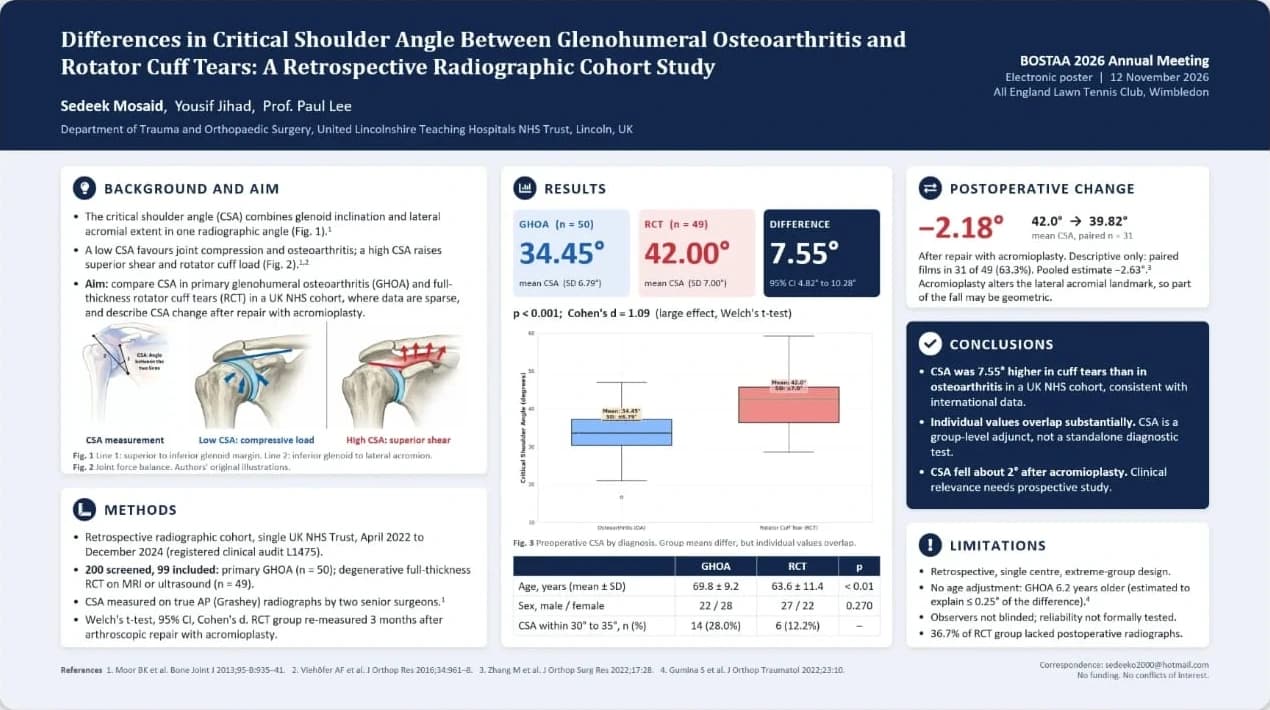
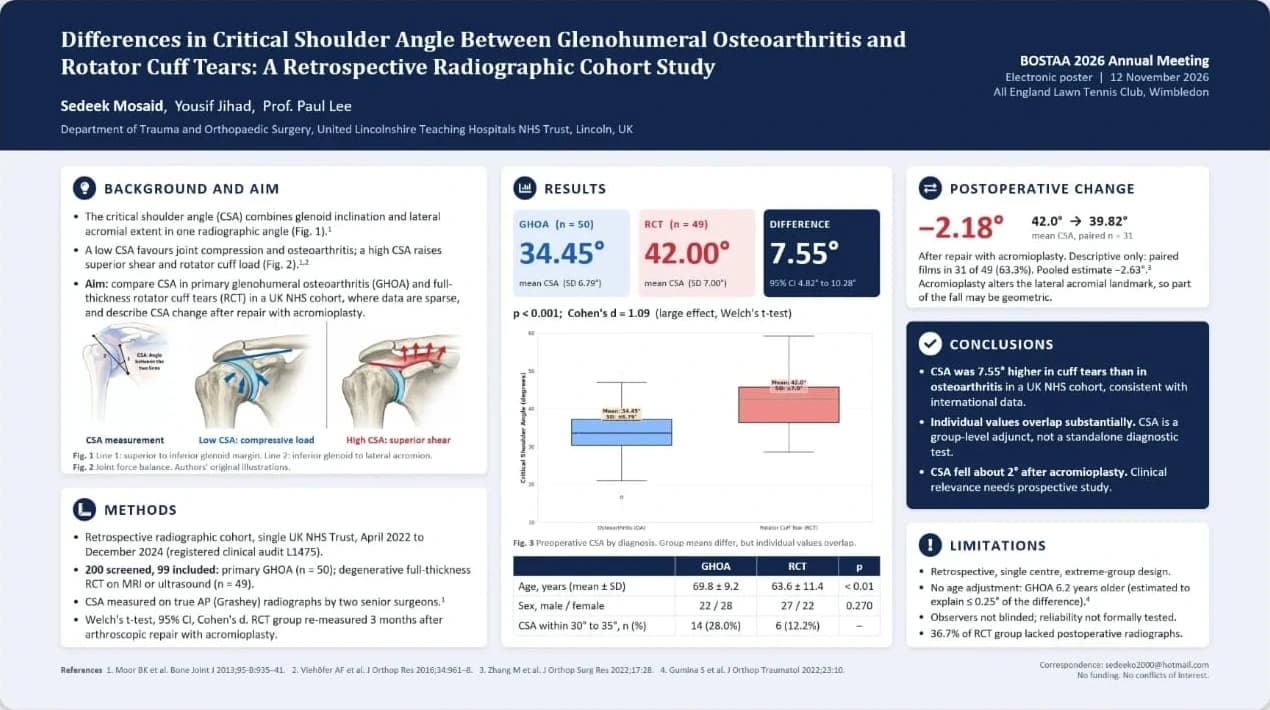
A retrospective radiographic cohort of 99 patients from a UK NHS trust comparing the critical shoulder angle in primary glenohumeral osteoarthritis and full-thickness rotator cuff tears. Mean CSA was 7.55° higher in cuff tears, a large effect, although individual values overlapped substantially.
Where and when
- Accepted
BOSTAA 2026 Annual Meeting
British Orthopaedic Sports Trauma and Arthroscopy Association
November 2026All England Lawn Tennis Club, Wimbledon, London, United Kingdom
Authors
- Sedeek Mosaid — Presenting author, United Lincolnshire Teaching Hospitals NHS Trust, Lincoln
- Yousif Jihad — Co-author, United Lincolnshire Teaching Hospitals NHS Trust, Lincoln
- Paul Lee — Co-author, United Lincolnshire Teaching Hospitals NHS Trust, Lincoln
Clinical audit: L1475
Themes
Scientific Focus
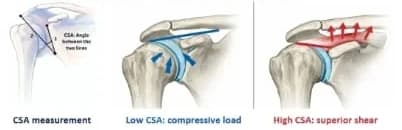
The critical shoulder angle (CSA) combines glenoid inclination and lateral acromial extent in a single radiographic measurement. A low CSA favours joint compression and osteoarthritis; a high CSA raises superior shear and rotator cuff load. The study compared CSA in primary glenohumeral osteoarthritis (GHOA) and full-thickness rotator cuff tears (RCT) in a UK NHS cohort, where data are sparse, and described how CSA changed after cuff repair with acromioplasty.
This was a retrospective radiographic cohort from a single UK NHS trust, April 2022 to December 2024, registered as clinical audit L1475. Of 200 patients screened, 99 were included: 50 with primary GHOA and 49 with degenerative full-thickness RCT confirmed on MRI or ultrasound. Two senior surgeons measured CSA on true anteroposterior (Grashey) radiographs. Groups were compared with Welch’s t-test, 95% confidence intervals and Cohen’s d, and the RCT group was re-measured three months after arthroscopic repair with acromioplasty.
Results
| GHOA (n = 50) | RCT (n = 49) | p | |
|---|---|---|---|
| Mean CSA, degrees (SD) | 34.45 (6.79) | 42.00 (7.00) | < 0.001 |
| Age, years (mean ± SD) | 69.8 ± 9.2 | 63.6 ± 11.4 | < 0.01 |
| Sex, male / female | 22 / 28 | 27 / 22 | 0.270 |
| CSA within 30° to 35°, n (%) | 14 (28.0%) | 6 (12.2%) | — |
Table 1. Preoperative critical shoulder angle and baseline characteristics by diagnosis. GHOA, glenohumeral osteoarthritis; RCT, full-thickness rotator cuff tear. CSA compared with Welch’s t-test.
A · CSA measurement and joint loading
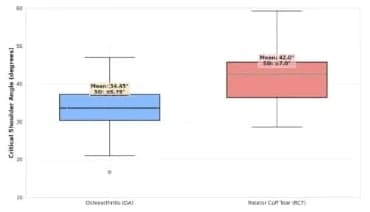
B · Preoperative CSA by diagnosis
Why It Matters
Mean CSA was 34.45° (SD 6.79°) in osteoarthritis and 42.00° (SD 7.00°) in cuff tears, a difference of 7.55° (95% CI 4.82° to 10.28°; p < 0.001; Cohen’s d = 1.09, a large effect). This is consistent with international data. Individual values overlapped substantially, however, so CSA is a group-level adjunct rather than a standalone diagnostic test.
After repair with acromioplasty, mean CSA fell from 42.0° to 39.82° (−2.18°) in the 31 of 49 patients (63.3%) with paired films, against a pooled published estimate of −2.63°. This change is descriptive only: acromioplasty alters the lateral acromial landmark, so part of the fall may be geometric, and its clinical relevance needs prospective study.
The authors note the limitations: a retrospective, single-centre, extreme-group design; no age adjustment, with the GHOA group 6.2 years older (estimated to explain no more than 0.25° of the difference); observers who were not blinded and reliability not formally tested; and 36.7% of the RCT group without postoperative radiographs.
 View full size
Next in the programme
Hormones, Muscle and Bone as Longevity Axes: Regeneration by Design
Sofia Life Summit 2026 · November 2026